
Website Update Strategy & Execution
Your website needs work. How much, and in what order?
The site isn’t broken, exactly. It’s just accumulated a list: pages that read like an old brochure, a design that’s dated in places, sections nobody’s touched since a staff member left, things it should do and doesn’t. A full rebuild feels like too much money and too much disruption; doing nothing means the list keeps growing. This engagement turns the list into a plan — what to do, in what order, at what cost — and then executes it in stages, with your website up and working the entire time.

How the plan comes together
- 01 — The list
Everything goes on the table first: the things that bug you, the things that bug your staff, the wishlist items that come up every meeting and never happen, plus whatever we find that you haven’t noticed yet. Nothing gets judged at this stage. The point is one complete list in one shared document instead of a dozen half-remembered conversations.
- 02 — The order
Then the list gets ranked, and this is where the strategy actually lives. Each item gets weighed by what it returns against what it costs — in money, in your team’s time, in disruption. Some items jump the queue because they’re quick and the payoff is immediate. Some fall to the bottom because they’re expensive and mostly cosmetic. The output is a sequenced plan with features, specs, and associated costs attached, and like everything we put on paper: nothing is set in stone.
- 03 — The gathering
Fair warning about the slowest part. On nearly every project we’ve ever run, the bottleneck isn’t design or development — it’s collecting the material: the photos, the service details, the paragraphs only you can supply. Clients who show up with all of it organized sit somewhere around the 96th percentile — a real number from real projects. The plan assumes you won’t be one of them, builds the collection work into the schedule, and gives you one document and one spreadsheet to fill instead of a scavenger hunt.
- 04 — The execution
Work lands in stages: necessities first, the shinier items after, each stage finished and live before the next one starts. Changes are built and checked out of sight, then rolled onto the live site — there is no point in the process where your website is down, half-painted, or gone. That’s a commitment, not a preference: we will not put a business through a stretch of having no working website.
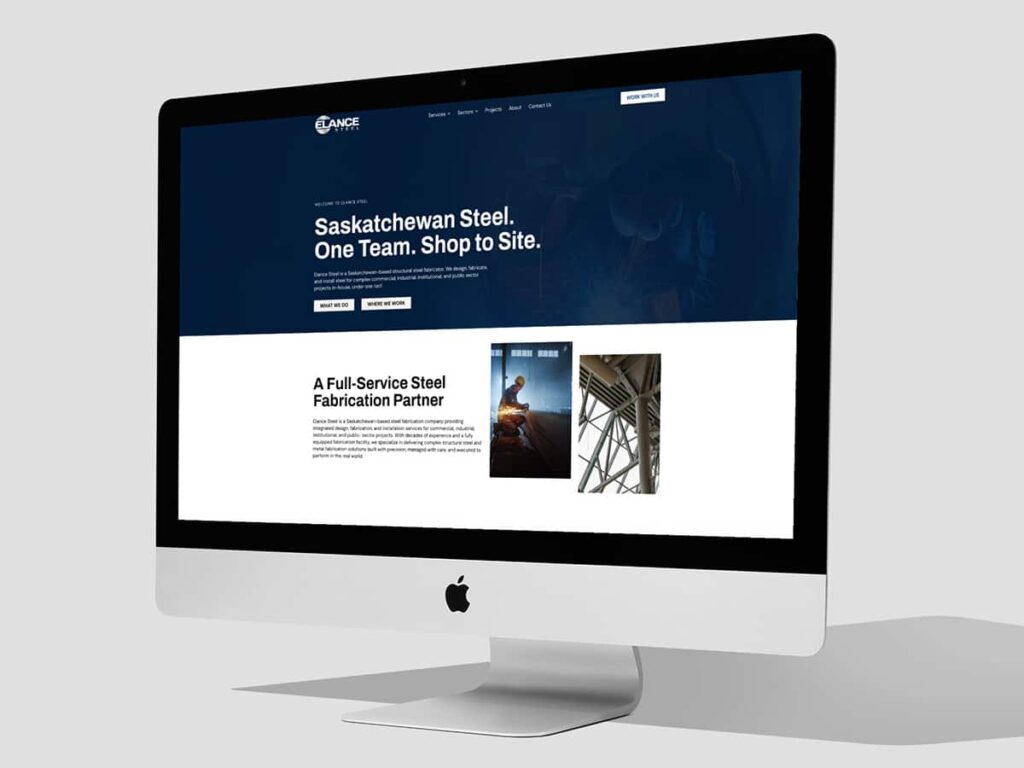 Elance SteelConstruction Companies & Contractors
 PDS IncHealth Care
 Modern ClosetContractors


When the answer is a rebuild, this is the shop
Not every engagement ends in one. When it does, the work lands here — browse it before you decide who to call.
One plan, no surprises
The plan itself is a document you could, in principle, hand to anyone: the itemized work, the order, the costs, the schedule. In practice most clients have us execute it, and then one standing rule governs everything that follows. If something comes up that’s outside the plan — a new idea, a surprise, a “while you’re in there” — you hear what it costs and how long it takes before it happens, and you say yes or no. No surprise invoices, ever. That rule has outlasted every project we’ve applied it to.
Not every website deserves saving
Update work is good business for us — a long list of billable improvements is, commercially speaking, a lovely thing. Which is why you should hear this from us up front: sometimes the honest math says stop. When a site is old enough, or was built badly enough, the update plan starts costing more than starting over — and when the numbers cross that line, the plan will say so, with both bills estimated in the open, and you decide.
The other honest thing: updates ship when they’re useful, not when they’re perfect. Perfect is the enemy of the good in this work. A page that’s 90% right and live today beats the flawless version that ships next quarter — we launch, we watch how real visitors use it, and we adjust. That loop is the whole method.
Same method, different scales
The engagement Thorpe hired us for turned into a different engagement midway — three companies became one website mid-plan — and because the work was sequenced, the change was a re-order rather than a restart. Cuelenaere LLP ran the quieter version of the same idea: a list, an order, and a working site the whole way through. Different scales, same method.





The rhythm after the work
Once the planned work is done, the site drops into a normal rhythm: the month-to-month changes run through WordPress management — most updates are small, and small updates are fast — while anything structural that surfaces later gets quoted under the same no-surprises rule, with the bigger jobs handled by the design side of the shop.
If you’re not sure yet what the site needs — if the problem is a feeling rather than a list — start one door over with a Comprehensive Website Review, which produces the findings this engagement turns into a plan. Both live under Digital Strategy.
Start with the top three
Send us your website’s address and the three things about it that bug you most — yours or your team’s, no ranking required. We’ll tell you whether they add up to an update plan, a smaller fix you don’t need us for, or a bigger conversation. You’ll know which before anything costs anything.